Natural vs Lab-Grown Diamonds: India Buyer Guide 2026
 A P Jewellers
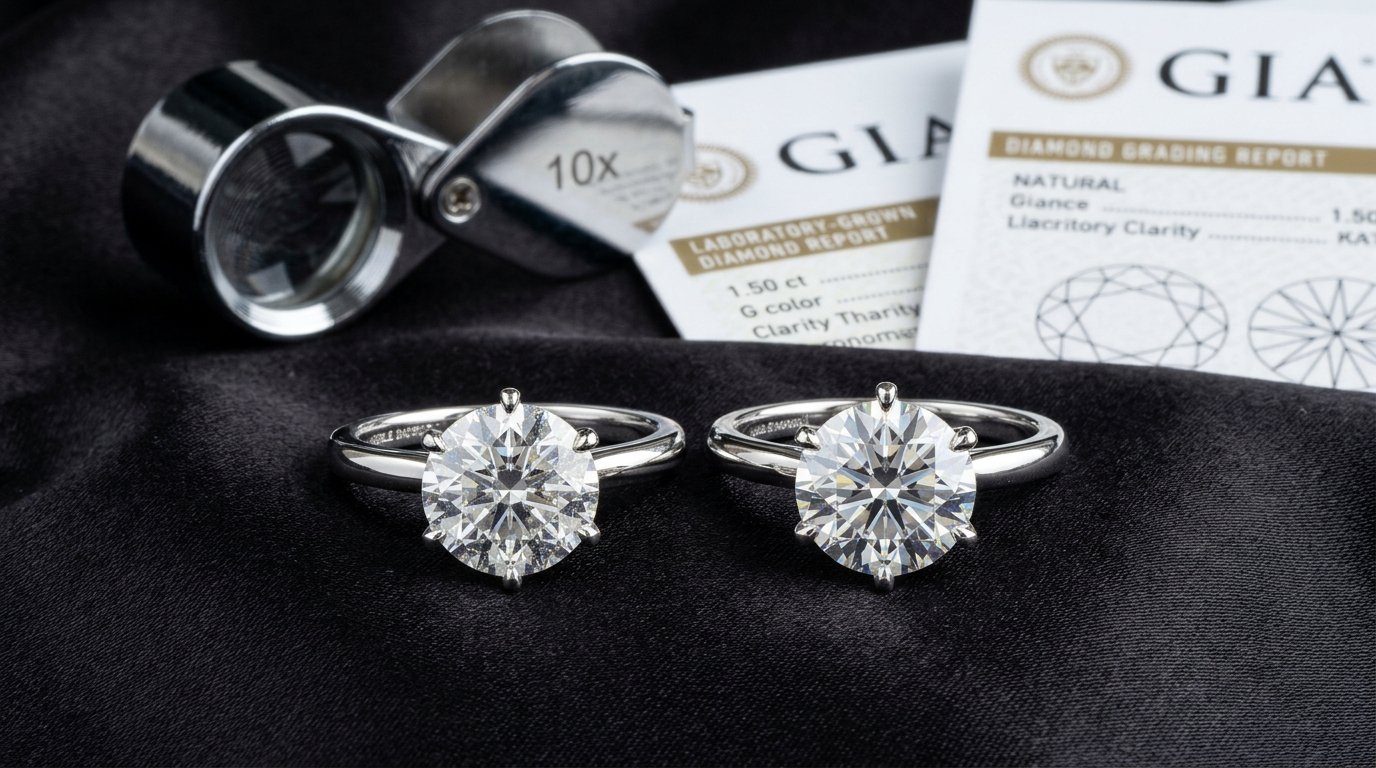
The useful question is not “Which diamond is real?” Both natural and laboratory-grown diamonds are diamonds. The useful question is: which origin, quality, price and long-term expectation fit this purchase? An engagement ring meant to become a family heirloom may lead to a different answer than fashion earrings chosen for maximum visual size.
Natural vs laboratory-grown diamond: side-by-side
| Decision factor | Natural diamond | Laboratory-grown diamond |
|---|---|---|
| Origin | Formed through geological processes in the earth and later mined. | Created in a controlled facility, commonly through HPHT or CVD growth. |
| Material | Diamond crystal made primarily of carbon. | Diamond crystal with essentially the same chemical, physical and optical properties. |
| Naked-eye look | Appearance depends on cut, colour, clarity, carat and setting. | Also depends on cut, colour, clarity, carat and setting; origin generally cannot be confirmed by sight alone. |
| Durability | 10 on the Mohs hardness scale; still vulnerable to chipping at edges or sharp points. | Also 10 on the Mohs hardness scale; the setting and cut shape still need care. |
| Upfront price | Normally higher for a comparable combination of characteristics. | Normally lower, often allowing a larger-looking centre stone within the same starting budget. |
| Supply story | Finite geological origin and established heritage positioning. | Technology-led production with supply that can expand and pricing that may change quickly. |
| Resale expectation | May have a more established secondary market, but recovery is not guaranteed and retail price is rarely recovered in full. | Secondary-market policies are less predictable; assume enjoyment and upfront savings rather than promised resale. |
| Best fit | Buyers prioritizing natural origin, rarity narrative, tradition or heirloom preference. | Buyers prioritizing visual size, design flexibility and lower upfront stone cost. |
Are laboratory-grown diamonds real?
Yes. GIA explains that laboratory-grown diamonds have essentially the same chemical composition, crystal structure, optical and physical properties as diamonds formed in nature. They are not the same as diamond simulants such as cubic zirconia or moissanite, which can resemble a diamond but have different compositions and properties.
The word real can still cause confusion because it mixes material identity with origin. Use precise language:
- Natural diamond: diamond of natural geological origin.
- Laboratory-grown diamond: diamond created by a technological growth process.
- Diamond simulant: a different material designed to imitate the look of diamond.
- Treated diamond: a diamond whose colour, clarity or appearance has been modified; treatment should be disclosed.
What India's BIS diamond standard changes for buyers
BIS published IS 19469:2025 to improve consumer clarity in diamond descriptions, labelling and advertising. Its central rule is straightforward: the unqualified word “diamond” refers to a natural diamond. A laboratory-grown or treated diamond must be clearly disclosed with accurate, unambiguous wording.
The standard also calls for disclosure of treatments, including modifications such as colour enhancement or fracture filling. Ask about treatment separately from origin: a natural stone can be treated, and a laboratory-grown stone can also receive post-growth treatment.
Can a jeweller tell the origin by looking?
Not reliably by naked-eye appearance. A well-cut natural diamond and a well-cut laboratory-grown diamond with similar graded characteristics can look alike. GIA notes that advanced instruments are used to definitively distinguish origin because traditional observations alone may not be enough.
Home “fog,” water, newspaper or sparkle tests do not establish natural versus laboratory-grown origin. A basic thermal tester may help separate some simulants, but it cannot replace a gemological laboratory's origin determination.
Price, resale and the word “investment”
A laboratory-grown diamond's lower upfront price is a real consumer benefit when the goal is more visible size or a more elaborate design within a fixed budget. But expanding production and technological improvement can place downward pressure on replacement and resale prices. Natural diamonds operate under different supply economics and have a longer-established secondary market, yet quality, demand, dealer margins and buyback policy still control the actual offer.
For both origins:
- Retail price includes the stone, metal, design, setting, making, tax and seller margin—not only an easily tradable commodity value.
- A grading report describes the stone; it does not promise a future price.
- “Buyback” may mean cash purchase, store credit or exchange toward another item. Those are not equivalent.
- A policy can exclude damage, missing reports, small stones or certain categories.
- Written terms matter more than a verbal resale percentage.
A sensible default is to buy diamond jewellery primarily for wear and meaning. If future value matters, request the exact policy before purchase and keep the invoice, grading report and product photographs together.
Use the 4Cs in the right order
Carat, colour, clarity and cut describe diamond quality, but they do not have equal visual impact. For a round brilliant, cut quality often has the strongest effect on brightness and sparkle. For fancy shapes such as oval, pear or emerald, proportions and light performance need closer visual comparison because a single headline grade cannot describe every outline.
- Set the complete ring budget. Reserve money for the metal, setting, tax and future resizing—not only the centre stone.
- Choose shape and cut performance first. A lively smaller stone often looks better than a dull larger one.
- Select an eye-clean clarity range. Do not pay for microscopic perfection you cannot appreciate unless rarity is the goal.
- Judge colour in the intended metal. White metal can reveal warmth differently from yellow or rose gold.
- Compare millimetre measurements. Two diamonds of the same carat can face up at different sizes.
How to verify a diamond grading report
Use the term grading report rather than assuming a “certificate” guarantees price. An independent report can document origin and measurable characteristics, but you must still match the report to the physical stone.
- Read the origin line: it should clearly say natural or laboratory-grown, not leave you to infer from price.
- Enter the report number yourself: use GIA Report Check or IGI Verify Your Report, depending on the issuing laboratory.
- Match the data: compare shape, measurements, carat weight, colour, clarity, cut/finish and comments with the supplied report.
- Check the inscription where present: ask to view the girdle inscription under magnification and match it to the report number. Not every stone/report has the same inscription format.
- Read treatment and growth comments: note HPHT/CVD growth and post-growth treatment disclosures where reported.
- Keep the original documentation: save the invoice, report details, item photo, SKU/design code and written policy.
Which diamond should you choose?
Natural diamond may suit you if…
- natural geological origin is part of the emotional value;
- family tradition or heirloom preference is important;
- you accept a smaller stone or higher budget for comparable grades;
- you have reviewed a credible written exchange/buyback policy.
Laboratory-grown may suit you if…
- you want more visible size or design impact for the budget;
- you are comfortable with technology-led origin;
- the jewellery is primarily for wear rather than resale expectations;
- the product and report clearly disclose origin and treatment.
For engagement rings, also consider lifestyle. Low-set bezels and protected halos can be practical for hands-on work; high solitaires can catch on clothing. Sharp shapes such as pear and marquise benefit from protected points. These setting choices matter regardless of diamond origin.
Be careful with environmental claims
“Mined” does not by itself tell you the full social or environmental record of a natural diamond, and “made in a lab” does not automatically make a laboratory-grown diamond carbon-neutral. Production energy source, traceability, mine practices, manufacturing efficiency and third-party evidence all matter.
If sustainability influences your choice, ask for specific documentation: producer, country, energy claim, audit/certification scope and whether the claim covers the stone only or the complete jewellery supply chain. Treat unqualified “eco-friendly,” “green” or “conflict-free” claims as questions, not conclusions.
Diamond jewellery invoice checklist
- Explicit stone origin: natural diamond or laboratory-grown diamond.
- Report laboratory and report number for the relevant certified stone.
- Shape, carat weight and graded characteristics.
- Any treatment or post-growth treatment disclosure.
- Number/weight and description of smaller side stones where relevant.
- Gold purity, net metal weight, hallmark/HUID and making charges.
- Ring size and resize limitations.
- Return, repair, lost-stone, exchange and buyback terms.
Frequently asked questions
Is a laboratory-grown diamond a fake diamond?
No. It is a diamond with essentially the same chemical, physical and optical properties as a natural diamond. Cubic zirconia and moissanite are different materials used as diamond simulants.
Can I identify a laboratory-grown diamond at home?
Not reliably. Origin can require advanced laboratory instruments. Home fog, water or sparkle tests cannot establish natural versus laboratory-grown origin.
Do laboratory-grown diamonds last as long as natural diamonds?
Both are diamond and rate 10 on the Mohs hardness scale. Either can still chip at an exposed edge or point, and the jewellery setting needs inspection and care.
Which has better resale value?
Natural diamonds generally have a more established secondary market, while laboratory-grown pricing and policies can be less predictable. Neither guarantees recovery of the original retail price; get the actual written policy.
Does a grading report guarantee diamond value?
No. A grading report documents identity and characteristics. It is not a future-price guarantee or a substitute for an appraisal, invoice or buyback policy.
What is CVD or HPHT?
They are common diamond-growth processes. CVD uses a carbon-containing gas/plasma process, while HPHT recreates high-pressure, high-temperature conditions. The report may also disclose post-growth treatment.
Should I choose a larger laboratory-grown stone or a smaller natural stone?
Choose based on what you value: visual size and upfront affordability lean laboratory-grown; natural origin and heritage preference lean natural. Compare cut performance and the complete ring—not carat alone.
Compare both options on the same checklist
Share your occasion, complete budget, preferred shape and ring size. Ask to compare origin disclosure, cut appearance, grading report and written policy before choosing.
WhatsApp Diamond Desk Natural diamond designs Laboratory-grown designs- BIS IS 19469:2025 consumer summary—diamond terminology, origin and treatment disclosure.
- GIA: simulants, moissanite and laboratory-grown diamonds—material and identification differences.
- GIA identification FAQ—need for advanced instrumentation.
- IGI laboratory-grown diamond report guide—report contents and verification.
Reviewed 31 August 2026. Product pricing and buyback policies can change; compare current written quotations rather than generic resale percentages.
Coordinate Custom Ornaments
Have questions about gold purities, bis certifications, or design rates discussed in this article? Chat with our experts directly.